
Understanding the allocation of national wealth toward defense is not merely a matter of geopolitics; it is a fundamental component of macroeconomic analysis. For investors, policymakers, and business leaders, the percentage of Gross Domestic Product (GDP) dedicated to military spending serves as a critical indicator of a nation’s fiscal priorities, its perceived security environment, and its long-term economic trajectory.
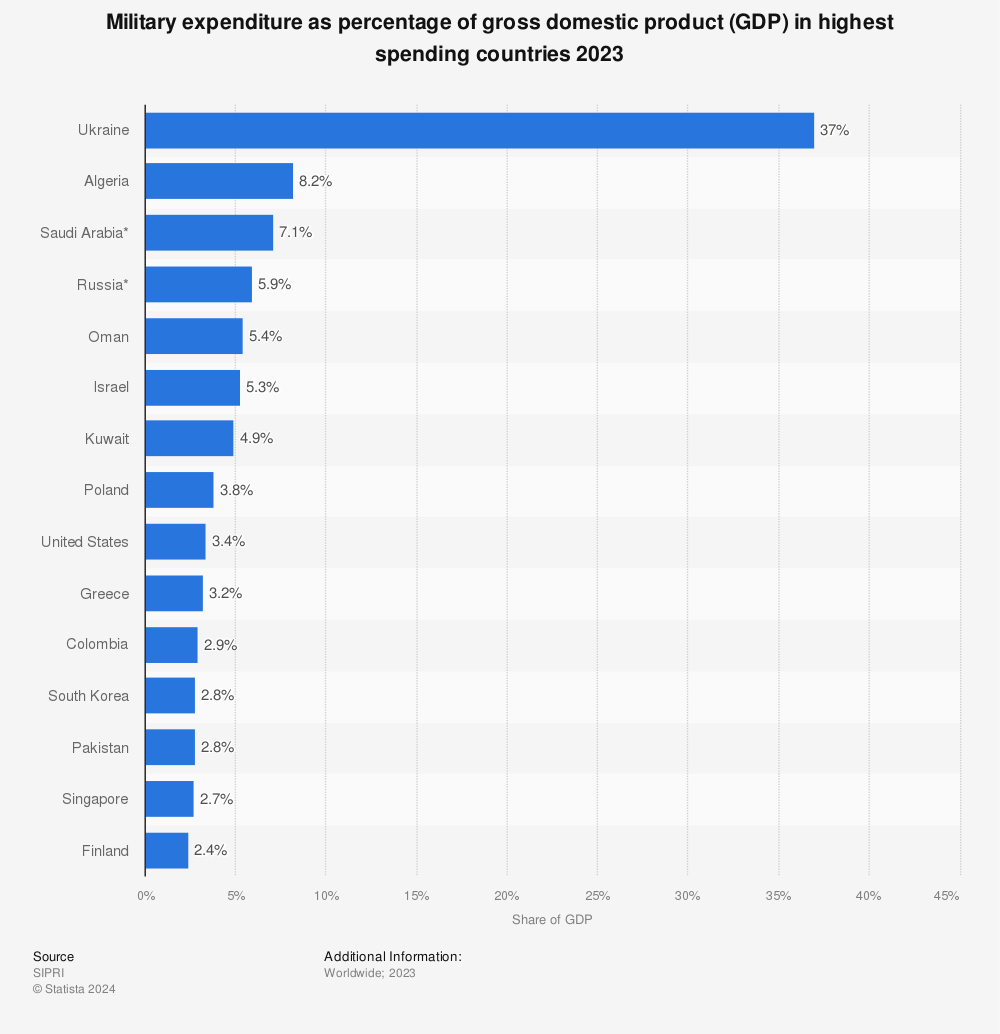
On a global scale, military expenditure has historically fluctuated in response to conflict, technological advancement, and shifting alliances. According to recent data from the Stockholm International Peace Research Institute (SIPRI), global military spending has reached record highs, surpassing $2.4 trillion annually. On average, the world spends approximately 2.2% to 2.3% of its total GDP on defense. However, this average masks significant disparities between nations, ranging from less than 1% in some stable democracies to over 10% in regions characterized by chronic instability.
The Global Benchmark: Understanding the 2% Standard
The most frequently cited benchmark in international defense finance is the NATO 2% target. Established during the 2014 Wales Summit, this guideline encourages member states to allocate at least 2% of their GDP to defense by 2024. For years, many European nations fell short of this goal, viewing high defense spending as an unnecessary burden during times of relative peace—a period often referred to as the “peace dividend.”
However, the financial landscape of European defense has shifted dramatically. In the wake of recent regional conflicts, most notably the invasion of Ukraine, nations like Germany have undergone a “Zeitenwende” (historic turning point), committing to massive increases in defense budgets. This shift represents a significant reallocation of capital. When a nation moves from spending 1.2% of GDP to 2%, it isn’t just a budgetary adjustment; it is a redirection of billions of dollars from social services, infrastructure, or debt reduction into the defense industrial base.
The Fiscal Burden of High-Spending Nations
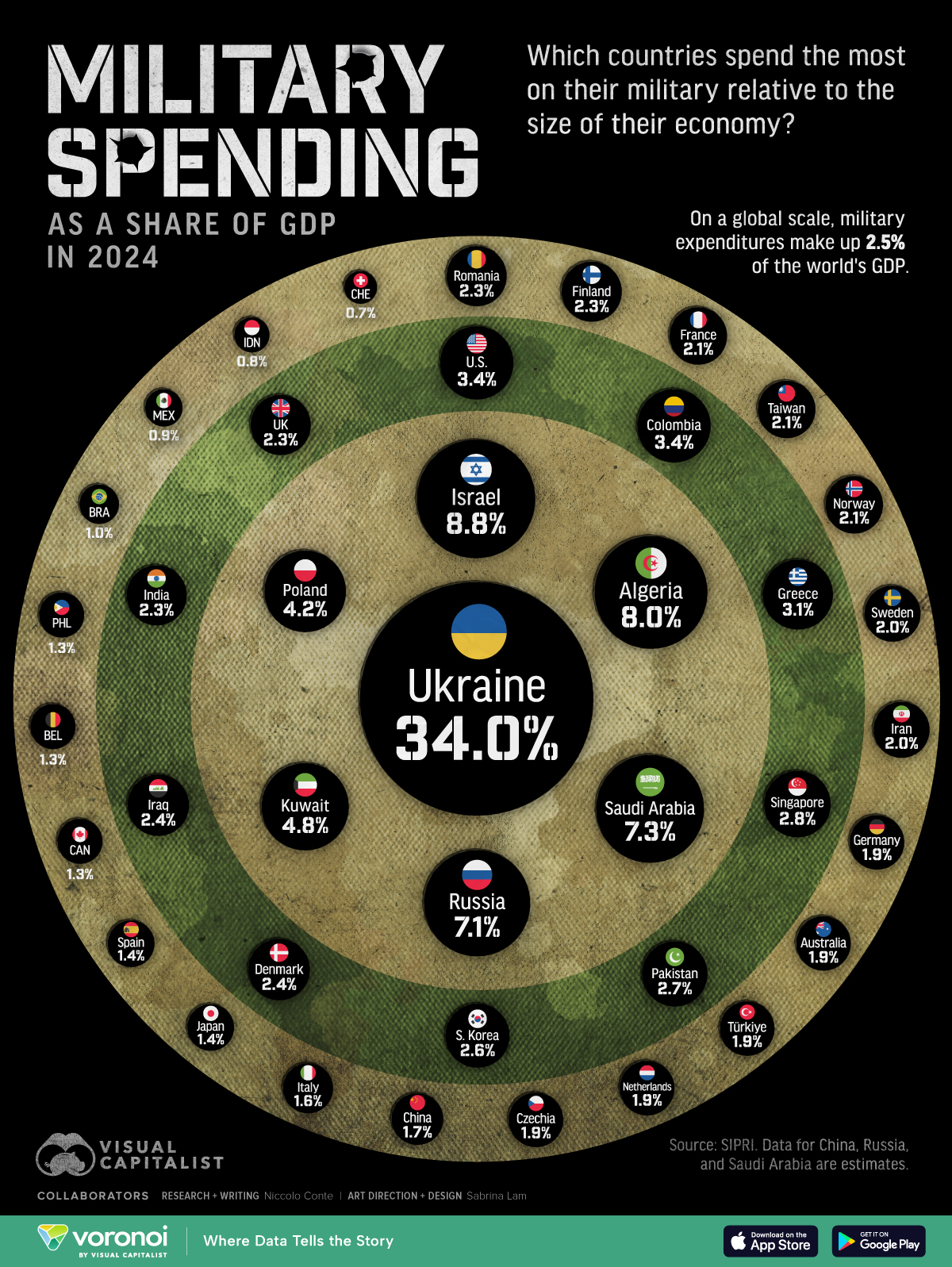
While the 2% target is a floor for NATO, other nations operate on a different scale entirely. Saudi Arabia, for instance, has historically spent upwards of 7% to 9% of its GDP on defense, driven by regional security concerns and a desire to modernize its armed forces. Israel, similarly, maintains a high ratio, often hovering between 4% and 5%.
From a business finance perspective, these high percentages represent a double-edged sword. On one hand, they support a robust domestic defense industry that can lead to high-tech exports. On the other hand, they place immense pressure on the national budget, often requiring high levels of taxation or the diversion of funds from human capital development.
The Superpowers: USA vs. China in the Fiscal Arena
The most significant players in the global defense market are the United States and China. Their spending patterns dictate global trends and influence the strategic planning of defense contractors worldwide.
The United States: The 3.5% Paradigm
The United States remains the largest military spender in the world, both in absolute terms and as a percentage of GDP among major Western economies. Currently, the U.S. spends approximately 3.4% to 3.5% of its GDP on defense. While this is lower than the Cold War peaks of 7% to 10%, it still represents nearly $900 billion in annual outlays.
For the American economy, this spending acts as a massive industrial policy. A significant portion of this GDP percentage goes toward Research and Development (R&D). Investors closely monitor the Department of Defense (DoD) budget because it is a primary driver for major corporations like Lockheed Martin, Raytheon (RTX), and Northrop Grumman. When the “percent of GDP” allocated to defense increases, it signals a bullish period for the aerospace and defense sectors, often leading to increased dividends and stock buybacks within those industries.
China: The Growth and Transparency Challenge
China’s military spending is officially reported at around 1.6% to 1.7% of its GDP. While this percentage is lower than that of the U.S., the sheer size of China’s economy means its absolute spending is second only to America. However, many financial analysts suggest the real figure is likely higher due to differences in how “defense-related” activities are categorized.
For the global market, China’s spending is a bellwether for regional stability in the Indo-Pacific. A rising percentage of GDP dedicated to the military in China often correlates with increased defense spending in neighboring economies like Japan, South Korea, and Australia, creating a cycle of capital expenditure across the region.
The Economics of “Guns vs. Butter”
In classical economics, the “Guns vs. Butter” model illustrates the trade-off between spending on military defense and spending on civilian goods. When a nation increases its military spending as a percentage of GDP, it must inevitably face the opportunity cost of that capital.
The Crowding Out Effect
One of the primary concerns for financial planners is the “crowding out” effect. High military spending requires significant government borrowing. When the government enters the credit markets to fund defense projects, it can drive up interest rates, making it more expensive for private businesses to borrow and invest.
Furthermore, if a country spends 4% of its GDP on the military while its infrastructure is crumbling, the long-term productivity of the economy may suffer. Investors look at the “efficiency” of defense spending: Is the money going into innovative tech that could have civilian applications, or is it going into maintaining aging equipment?
Defense as a Catalyst for Innovation
Conversely, military spending has historically been a major driver of technological breakthroughs that eventually fuel private sector growth. The internet, GPS, and jet engines all began as military projects funded by a percentage of the national GDP. From an investment standpoint, high defense R&D spending can be viewed as a “long-call option” on future civilian technologies.
In the current era, the focus has shifted toward Artificial Intelligence (AI), cybersecurity, and quantum computing. As governments allocate a higher percentage of GDP to these areas within their defense budgets, they are effectively subsidizing the next generation of tech giants.
Analyzing the Impact on National Debt and Inflation
Military spending is inherently different from other types of government expenditure because it does not directly produce consumer goods or services. This characteristic can have unique impacts on a nation’s financial health.
Inflationary Pressures
High defense spending can be inflationary. It puts money into the hands of workers and contractors without increasing the supply of goods available for purchase in the civilian market. If a government increases its defense-to-GDP ratio too rapidly without corresponding tax revenue, it runs the risk of overheating the economy or devaluing its currency.
Debt Sustainability
For countries with high debt-to-GDP ratios, every percentage point spent on the military is a point that cannot be used to pay down the national debt. In the United States, interest payments on the national debt are now rivaling the defense budget in size. This creates a fiscal “pincer movement” where the government must find a way to fund both its security obligations and its debt obligations without stifling economic growth.
Financial analysts use the defense-to-GDP ratio to assess sovereign risk. If a country’s military spending is rising faster than its GDP growth, it may signal future fiscal instability or a looming debt crisis.
Investing in a High-Defense Environment
For those focused on money and investing, the percentage of GDP spent on the military is a key fundamental metric. It dictates the “top-line” revenue potential for the entire defense sector.
Sector Rotation and Policy Shifts
When geopolitical tensions rise, we often see a sector rotation where investors move capital into defense stocks. These companies are often viewed as “defensive” investments—not just because they make weapons, but because their revenue is backed by long-term government contracts that are less sensitive to consumer economic cycles.
A rising national defense budget as a percentage of GDP usually translates to:
- Long-term Contract Security: Multi-year programs for aircraft carriers, fighter jets, or missile defense systems.
- High Barriers to Entry: The specialized nature of defense work means new competitors cannot easily enter the market.
- Dividend Stability: Many major defense firms are known for consistent dividend payouts, making them attractive for income-focused portfolios.
The Shift Toward “Dual-Use” Technology
Modern military spending is increasingly focused on software and digital infrastructure. This has opened the door for “dual-use” companies—those that serve both the defense and civilian markets. Palantir, SpaceX, and various cybersecurity firms are prime examples. These companies benefit from the massive capital infusion provided by defense budgets while maintaining the high-growth potential of the tech sector.

Conclusion: The Strategic Importance of the GDP Ratio
The question of “what percent of GDP is military spending” is far more than a statistical curiosity. It is a reflection of a nation’s risk assessment and its economic strategy. For a nation to maintain a high defense-to-GDP ratio, it must possess either a high level of economic productivity or a willingness to take on significant fiscal risk.
As we move further into the 2020s, the global average of 2.2% is likely to rise. The transition from a unipolar world to a multipolar one traditionally brings higher security costs. For the astute investor or business leader, tracking these percentages provides a roadmap of where government capital will flow, which industries will see the next wave of innovation, and which nations are prioritizing security over immediate consumption. In the world of finance, following the money leads directly to the national defense budget.
aViewFromTheCave is a participant in the Amazon Services LLC Associates Program, an affiliate advertising program designed to provide a means for sites to earn advertising fees by advertising and linking to Amazon.com. Amazon, the Amazon logo, AmazonSupply, and the AmazonSupply logo are trademarks of Amazon.com, Inc. or its affiliates. As an Amazon Associate we earn affiliate commissions from qualifying purchases.