
In the landscape of global commerce, few sectors command as much public fascination as the film industry. While audiences focus on the storytelling and the spectacle, the business world views cinema through the lens of capital expenditure, return on investment (ROI), and global market penetration. When asking “what movie grossed the most money ever,” the answer is not merely a single figure but a complex study in economic cycles, currency fluctuations, and the evolving nature of the global marketplace.
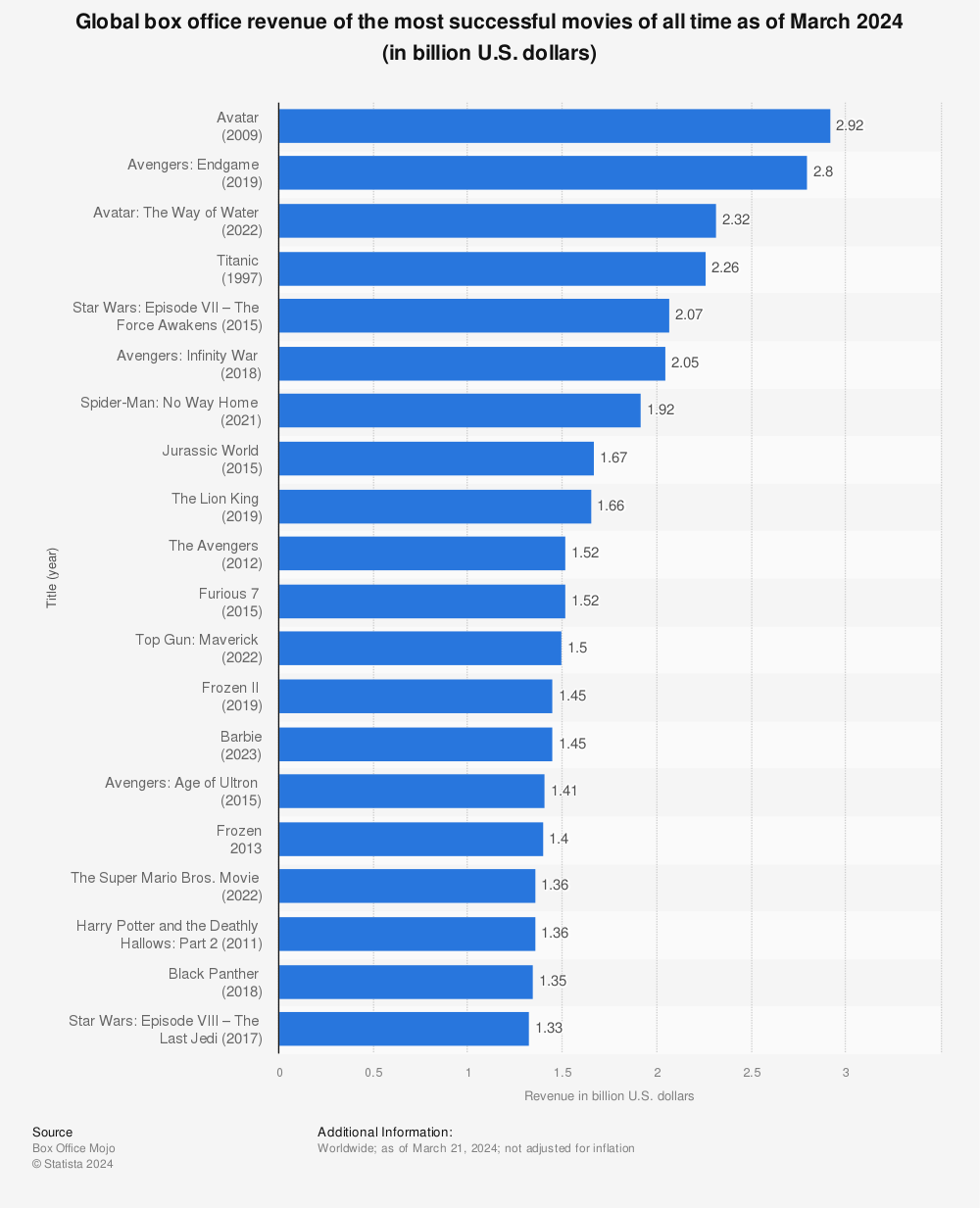
As of the current fiscal landscape, the title for the highest-grossing film of all time on a nominal basis belongs to James Cameron’s Avatar (2009). However, from a professional financial perspective, nominal figures often tell only half the story. To truly understand the financial titan of the film industry, one must look at the intersection of raw box office data, inflation adjustment, and the diversification of revenue streams.

Understanding Nominal vs. Real Value in Cinematic History
In finance, the distinction between nominal value (the face value of money) and real value (purchasing power adjusted for inflation) is critical. This distinction is the primary reason why the “highest-grossing” list is often a point of contention among economists and industry analysts.
The Avatar Phenomenon and the Unadjusted Crown
James Cameron’s Avatar currently sits atop the nominal throne with a global box office total exceeding $2.9 billion. From a business strategy standpoint, Avatar was a masterclass in market timing and technological proprietary value. It wasn’t just a movie; it was an “event” that leveraged premium pricing through 3D and IMAX formats. By charging a premium for the viewing experience, the production was able to extract higher per-capita revenue than traditional 2D films.
This strategy highlights a core principle in business finance: the ability to command premium pricing through innovation. Avatar didn’t just sell more tickets; it sold more expensive tickets. Its financial dominance was further solidified by a long theatrical “tail,” remaining in cinemas for months and benefiting from a global distribution network that had finally matured in emerging markets like China.
Gone with the Wind and the Power of Inflation Adjustment
When economists adjust box office receipts for inflation—calculating the “real value” of the currency—the leader changes significantly. Under this metric, the 1939 classic Gone with the Wind remains the undisputed champion. With an adjusted gross estimated at roughly $3.9 billion in today’s dollars, it represents a level of market saturation that is nearly impossible to replicate in the modern era.
The financial lesson here lies in the “theatrical window” and competition. In 1939, there were no streaming services, no television, and no home video. The cinema was the primary source of visual entertainment. Gone with the Wind benefited from multiple re-releases over several decades, a strategy that allowed it to recapture capital from new generations of viewers. For modern investors and brand strategists, this highlights the importance of longevity and the “long-tail” asset value in a portfolio.
The Revenue Drivers: How Modern Blockbusters Scale Profits
Gross box office numbers are the most visible metric of success, but they are only one component of a film’s total financial ecosystem. To understand how a movie “grosses the most money,” we must examine the diversified revenue streams that support these massive intellectual properties (IP).
Global Market Expansion and the “China Factor”
In the last two decades, the film industry has shifted from a North American-centric model to a truly global one. For a film to reach the $2 billion mark today, it must perform exceptionally well in international markets, particularly in China. The expansion of the middle class in emerging economies has created a massive new consumer base for high-budget entertainment.
From a business finance perspective, this requires a “Glocal” approach—creating a product with global appeal while ensuring local distribution partnerships are robust. Films like Avengers: Endgame ($2.79 billion) succeeded because they were engineered as global brands, utilizing marketing campaigns that transcended linguistic and cultural barriers. The logistics of global distribution, including currency hedging and navigating international tax credits, are now as important as the script itself.
Ancillary Revenue Streams: Merchandising and Licensing
While Avatar holds the theatrical record, it may not be the “most profitable” when considering the entire lifecycle of the brand. The true giants of revenue generation are often those that can pivot from the screen to the shelf.
Take, for example, the Star Wars franchise or the Marvel Cinematic Universe (MCU). The box office gross is frequently dwarfed by the revenue generated through toy sales, apparel, theme park attractions, and licensing deals. In corporate finance, this is known as a “multi-platform monetization strategy.” A film that grosses $1 billion at the box office might facilitate another $5 billion in retail sales over the following decade. For the modern media conglomerate, the movie is the “loss leader” or the primary marketing vehicle for a much larger retail ecosystem.
The Economics of Production: Risk Management in the $200 Million Era
Generating record-breaking revenue requires massive capital injection. The “tentpole” model of modern filmmaking involves budgets that often exceed $200 million for production alone, with an additional $100 million to $150 million allocated for global marketing.
Marketing Budgets: The Hidden Half of the Balance Sheet
When the public hears that a movie “grossed $1 billion,” there is a common misconception that the studio has realized a $1 billion profit. In reality, the “theatrical rental”—the portion of the ticket price that actually returns to the studio—is usually only about 50% in the US and significantly less in international markets.
Furthermore, the marketing budget (P&A, or Prints and Advertising) is a massive upfront cost that must be recouped before a film reaches the “break-even” point. High-grossing films are often high-risk investments. A movie like Avengers: Endgame required a complex web of financing, including slate funding, co-financing deals, and equity stakes from various production partners to mitigate the risk of a potential box office failure.
Break-Even Points and the Distribution Waterfall
In business finance, the “waterfall” refers to the order in which stakeholders are paid. Theaters take their cut first, followed by distributors, and then the talent (actors and directors with “backend” deals). Only after these obligations are met does the studio see a return.
The films that gross the most money are those that can clear these hurdles quickly. A film with a $300 million combined production and marketing cost might need to gross $700 million just to break even. Reaching the $2 billion mark isn’t just about prestige; it’s about achieving a margin that justifies the immense risk taken by the parent corporation and its shareholders.
Future Trends: The Shifting Financial Landscape of Cinema
The definition of “grossing money” is currently undergoing a seismic shift due to the rise of Direct-to-Consumer (DTC) streaming platforms. The traditional box office model is no longer the sole metric for a film’s financial health.
The Diminishing “Theatrical Window”
Historically, movies had a 90-day exclusive window in theaters before moving to home video or cable. Today, that window has shrunk to as little as 17 to 45 days. From a cash flow perspective, this allows studios to recoup their investment faster, reducing the cost of capital. However, it also threatens the long-term “theatrical gross” potential that allowed movies like Avatar to reach their record-breaking heights.
Investors are now looking at “Average Revenue Per User” (ARPU) on streaming platforms rather than just ticket sales. A film that draws 100 million viewers on a subscription service might be worth more in long-term enterprise value than a film that grosses $1 billion at the box office but fails to drive platform loyalty.

Data-Driven Greenlighting and the Role of AI in Financing
As we move forward, the process of creating the next “highest-grossing film” is becoming increasingly data-driven. Studios are using sophisticated algorithms to predict box office performance based on genre, cast, and even social media sentiment analysis. This “predictive financing” aims to reduce the volatility of the film industry.
By analyzing the historical data of high-grossing films, studios can identify the optimal “release windows” and market demographics to maximize their ROI. While this may lead to a more formulaic approach to filmmaking, from a business and financial standpoint, it represents a necessary evolution toward stability in a high-stakes industry.
In conclusion, while Avatar remains the nominal leader in box office history, the title of “the most money ever” is a moving target influenced by inflation, global market dynamics, and ancillary revenue. For the savvy financial observer, the true story isn’t just the number on the screen—it’s the massive, complex machinery of global finance that makes these cinematic billion-dollar milestones possible. Whether through ticket sales, licensing, or streaming subscriptions, the business of the “blockbuster” remains one of the most sophisticated examples of modern wealth creation and brand scaling.
aViewFromTheCave is a participant in the Amazon Services LLC Associates Program, an affiliate advertising program designed to provide a means for sites to earn advertising fees by advertising and linking to Amazon.com. Amazon, the Amazon logo, AmazonSupply, and the AmazonSupply logo are trademarks of Amazon.com, Inc. or its affiliates. As an Amazon Associate we earn affiliate commissions from qualifying purchases.