
The national deficit is a figure that frequently dominates financial news cycles, yet it remains one of the most misunderstood concepts in macroeconomics and personal finance. At its simplest level, the national deficit represents the difference between what the federal government spends and what it collects in revenue over a specific fiscal year. When the government’s outlays—ranging from social programs and defense to infrastructure and education—exceed its income from taxes and other fees, a deficit is created.
As of the current fiscal period, the national deficit remains a multi-trillion dollar focal point for economists and investors alike. Understanding the current state of the deficit requires moving beyond the raw numbers to examine the underlying structural components of the federal budget, the impact of monetary policy, and the long-term implications for individual wealth and market stability.
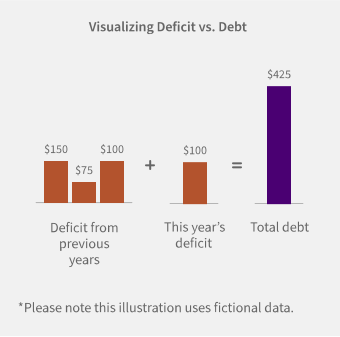
The Mechanics of the Federal Budget: Deficit vs. Debt
To grasp the magnitude of the deficit today, one must first distinguish it from the national debt. While the two terms are often used interchangeably in casual conversation, they represent distinct financial realities that influence the economy in different ways.
Understanding the Annual Shortfall
The national deficit is a “flow” variable. It is measured over a specific timeframe, usually the federal fiscal year which runs from October 1 to September 30. If the government brings in $4 trillion in tax revenue but spends $5.5 trillion, the deficit for that year is $1.5 trillion. This shortfall is typically covered by the Department of the Treasury through the issuance of government securities, such as Treasury bills, notes, and bonds.
In recent years, the deficit has been characterized by significant volatility. The response to global economic shocks, including the pandemic-era stimulus packages, saw the deficit reach historic peaks. Today, while the immediate emergency spending has tapered off, the structural deficit—the gap that remains even when the economy is operating at full potential—continues to be a major component of the national financial landscape.
The Accumulation of National Debt
The national debt, by contrast, is a “stock” variable. It is the cumulative total of all past annual deficits, minus any surpluses. Every time the government runs a deficit, it must borrow money to cover the gap, adding to the total debt. This distinction is crucial for investors because while a single year’s deficit might fluctuate based on legislative changes or economic cycles, the total debt represents the long-term burden on the economy.
The relationship between the deficit and the debt is a feedback loop. As the debt grows, the cost of “servicing” that debt—paying the interest to bondholders—increases. This interest expense then becomes a larger part of the annual budget, which, if not offset by revenue increases or spending cuts, further expands the annual deficit.
Driving Forces Behind the Current Deficit
The current scale of the national deficit is not the result of a single policy or event but rather the confluence of decades of fiscal trends. By analyzing where the money comes from and where it goes, we can better understand why the deficit remains a persistent fixture of the modern economy.
Federal Revenue: The Tax Collection Reality
The primary source of revenue for the federal government is taxes. Individual income taxes and payroll taxes (which fund Social Security and Medicare) make up the vast majority of these receipts. Corporate income taxes, customs duties, and excise taxes account for the remainder.
Today, revenue levels are heavily influenced by the health of the labor market and corporate profitability. However, even during periods of strong economic growth and high employment, revenue often fails to keep pace with the accelerating rate of federal spending. This gap is exacerbated by various tax expenditures—provisions in the tax code that reduce the amount of tax owed, such as deductions and credits—which effectively act as “hidden” spending.
Mandatory Spending: The Largest Slice of the Pie
The most significant driver of the deficit today is mandatory spending. These are outlays that are dictated by existing laws and do not require annual approval from Congress. This category includes “entitlement” programs such as Social Security, Medicare, and Medicaid.
As the demographic profile of the country shifts toward an older population, the costs associated with these programs naturally rise. Because these programs are indexed to inflation and are sensitive to healthcare costs, they exert a constant upward pressure on the deficit. For financial planners and retirees, the sustainability of these programs is a core concern, as any future attempt to reduce the deficit will likely involve discussions regarding these benefits.
Discretionary Spending and Emergency Appropriations
Discretionary spending is the portion of the budget that Congress must authorize every year. This includes defense, education, transportation, and various federal agencies. While defense spending remains a significant line item, it is often the focus of intense political debate.

Beyond regular discretionary spending, “emergency” or “supplemental” appropriations can cause the deficit to spike unexpectedly. Natural disaster relief, international aid, or economic stimulus measures can add hundreds of billions of dollars to the deficit in a single fiscal year, often with little lead time for budgetary adjustments.
The Rising Cost of Interest and Its Impact on the Economy
One of the most critical factors influencing the national deficit today is the cost of interest. For much of the last decade, interest rates were at historic lows, allowing the government to borrow large sums of money at a very low cost. However, as the Federal Reserve has raised rates to combat inflation, the landscape has shifted dramatically.
Debt Servicing as a Budgetary Line Item
The interest paid on the national debt is now one of the fastest-growing components of federal spending. When interest rates rise, the Treasury must offer higher yields on new bonds to attract investors. This means that a larger portion of the annual budget is dedicated simply to paying interest on money already borrowed, rather than being invested in infrastructure, technology, or social services.
For the individual investor, this signifies a “crowding out” effect. When the government must borrow aggressively to fund its deficit, it competes with the private sector for available capital. This can lead to higher borrowing costs for businesses and consumers, potentially slowing economic growth over the long term.
The Role of Interest Rates and the Federal Reserve
The Federal Reserve plays a complex role in the deficit narrative. While the Fed is technically independent of the Treasury, its monetary policy decisions—specifically regarding the federal funds rate—directly impact the cost of government borrowing.
In a high-inflation environment, the Fed raises rates to cool the economy. This, in turn, makes the deficit more expensive to maintain. Conversely, during economic downturns, the Fed may lower rates and engage in quantitative easing (buying government bonds), which can temporarily lower the government’s borrowing costs but may lead to long-term inflationary pressures. This delicate balance between fiscal policy (the government’s taxing and spending) and monetary policy (the Fed’s control of the money supply) is a primary driver of market volatility.
What the Deficit Means for Your Personal Finances
While the national deficit may seem like an abstract macroeconomic figure, its impact filters down to the average citizen’s bank account, investment portfolio, and future purchasing power.
Inflation and the Devaluation of Currency
One of the most immediate concerns regarding a high national deficit is the risk of inflation. If the government funds its deficit by essentially increasing the money supply or if the deficit leads to an overheating economy, the purchasing power of the currency can decline. This means that each dollar you save or earn buys fewer goods and services over time. For those on fixed incomes or those holding significant amounts of cash, a persistent deficit can be a silent thief of wealth.
Potential Changes to the Tax Landscape
Mathematically, there are only two ways to reduce a deficit: spend less or collect more. Given the political difficulty of cutting mandatory programs, many economists anticipate that high deficits today will lead to higher taxes tomorrow. For personal finance strategy, this suggests that tax-advantaged investment vehicles (like Roth IRAs or 401ks) and tax-efficient asset allocation become increasingly valuable. Investors must consider not just what they earn today, but what they will be allowed to keep in a future environment where the government is pressured to increase revenue.
Investment Strategies in a Deficit-Heavy Market
A high-deficit environment often correlates with increased volatility in the bond market. As the supply of Treasury securities increases to fund the deficit, bond prices can fall and yields can rise.
- Diversification: Investors may look to diversify away from traditional fixed-income assets, incorporating real estate, commodities, or international equities that may be less sensitive to domestic fiscal policy.
- TIPS: Treasury Inflation-Protected Securities (TIPS) can be an effective tool for those concerned that the deficit will drive long-term inflation, as the principal of these bonds adjusts based on changes in the Consumer Price Index.
- Equity Markets: Historically, equity markets have shown resilience in the face of deficits, but sectors sensitive to interest rates—such as utilities or high-growth tech—may experience more turbulence when the deficit drives borrowing costs higher.

Future Outlook: Navigating Long-Term Fiscal Sustainability
The trajectory of the national deficit today suggests that fiscal policy will remain a central theme in the financial world for years to come. While a deficit can be a useful tool for stimulating the economy during a recession, a permanent and growing structural deficit presents unique challenges.
The focus for policy analysts is often the “debt-to-GDP” ratio. This metric compares what the country owes to what it produces. As long as the economy grows faster than the debt, the deficit is generally considered manageable. However, if the deficit continues to outpace economic growth, it may lead to a loss of investor confidence and a potential credit downgrade for the sovereign nation, which would further increase borrowing costs.
For the savvy individual, “what the national deficit is today” is less about a single number and more about a trend. It is a signal of the future tax environment, the likely direction of interest rates, and the importance of a robust, diversified financial plan that can withstand the ebbs and flows of government fiscal policy. Staying informed on these trends is no longer just for economists—it is a fundamental requirement for anyone looking to build and protect wealth in the 21st century.
aViewFromTheCave is a participant in the Amazon Services LLC Associates Program, an affiliate advertising program designed to provide a means for sites to earn advertising fees by advertising and linking to Amazon.com. Amazon, the Amazon logo, AmazonSupply, and the AmazonSupply logo are trademarks of Amazon.com, Inc. or its affiliates. As an Amazon Associate we earn affiliate commissions from qualifying purchases.